
Jersey Dry Inc.Basement Water Response Call 1-866-925-3920

A sump pump is only as good as the three things attached to it

The pump, the pit, the discharge line and the power source are one system. Most failures we are called out to are not the pump — they are one of the other three.

Where sump systems actually fail

Homeowners replace pumps. We replace systems, because a new pump bolted into a bad pit with a frozen discharge line fails on exactly the same night the old one did. Four components, four failure modes:

01

The pump

Cast iron over plastic, every time — the housing sinks heat into the water instead of cooking the motor. Cheap vertical float switches are the single most common point of failure; a sealed mechanical or solid-state switch outlives them by years.
02

The pit

Too shallow and the pump short-cycles itself to death. Unlined and it fills with silt that eats the impeller. It should be at least eighteen inches across, lined, seated in stone, and sealed with a gasketed lid.

03

The discharge line

The most-ignored component and the most common winter failure. It needs distance from the foundation, a downhill run, a serviceable check valve, and a freeze-relief so a blocked outlet does not dead-head the pump.

04

The power

A dedicated GFCI circuit, not a shared basement outlet with a freezer on it. And a battery backup with its own charger, because storms take out the grid at the moment the pit is filling fastest.

Backup options

Three ways to survive the outage

Which one is right depends on how much water your pit moves and how long your street typically stays dark.

TypeRuns forBest when
DC battery backup6–12 hMost homes; moderate inflow
Dual battery bank12–30 hFinished basements, long outages
Water-powered backupIndefiniteMunicipal water, low inflow, no batteries to service

Battery systems need the battery replaced roughly every four to five years — a maintenance item people forget until the night it matters. We note the install date on the unit.

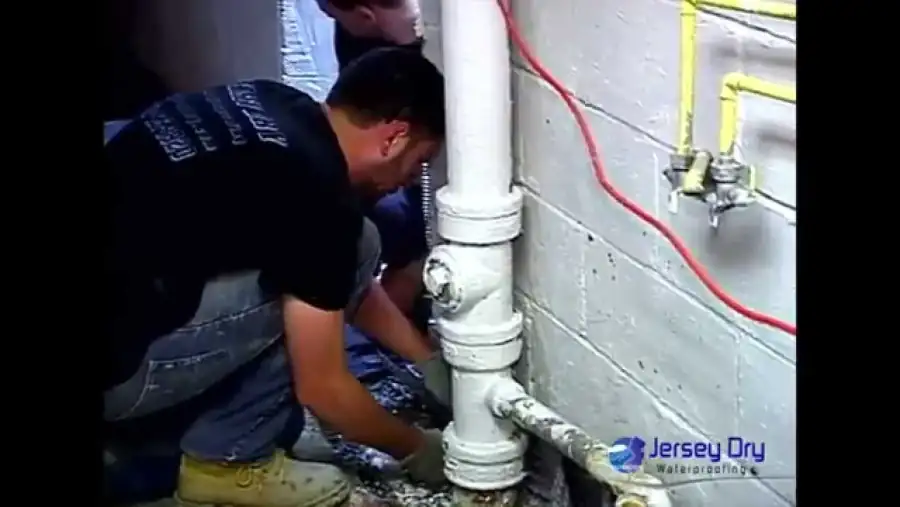
Two Jersey Dry technicians fitting a sump pump discharge line and check valve in a basement
Discharge and check valve assembly on a pump replacement

A two-minute test you can do this weekend

You do not need us to find out whether your pump works. Take a bucket of water, pour it slowly into the pit, and watch:

  • Float rises and the motor starts within a few seconds
  • Water level drops steadily, not in surges
  • Pump shuts off cleanly and does not restart
  • You hear a single click from the check valve, not chatter
  • Water actually exits at the discharge point outside
  • Nothing runs back into the pit after shutdown

Any one of those failing is worth a call. The last two are the ones people never check, and they are the ones that flood basements — water that leaves the pump and comes straight back is a system that will run until the motor burns out.

Worth knowing: a pump that has been sitting unused all winter can seize. If yours has not cycled since autumn, test it before spring rain rather than during it.

FAQ

Sump pump questions, answered plainly

How long does a sump pump last?

Seven to ten years for a decent cast-iron primary in typical New Jersey duty. Plastic builder-grade units frequently give out at four or five. Age matters less than cycle count — a pump in a high-water-table basement can wear out in half the time because it simply runs more.

Do I really need a battery backup, or is that an upsell?

Consider when your pump matters most: during the storm. That is also when the power goes out. A primary pump without a backup is a system that is guaranteed to be offline during the exact event it exists for. If your basement is finished or your pit runs more than a few times a week, a backup is not optional in any honest reading.

What size pump do I need?

Sizing is set by inflow rate and vertical lift, not by house size. We measure how fast the pit refills after being emptied and how high the water has to travel to reach the discharge point. A one-third horsepower unit handles most homes; deep lifts and heavy inflow want a half. Oversizing causes short-cycling, which kills pumps faster than undersizing.

Why does my sump pit smell?

An open pit is an evaporation surface connected to soil gas. Standing water in the bottom goes stagnant, and in some houses the pit is also a radon entry point. A sealed lid with a gasketed pass-through for the discharge and the float cord solves both problems and costs very little added to an installation you are already doing.

Can the discharge just go out through the wall?

It can, and it is where a lot of bad installations end. If the outlet sits near the foundation the water re-enters the soil you are trying to keep dry, and in January the last eighteen inches of that pipe freeze solid. Discharge should carry at least ten feet away, exit on a downhill grade, and have a freeze-relief fitting.

Can you replace a pump without tearing up the floor?

If the existing pit is sound and correctly sized, yes — a swap is a couple of hours. Pits that are too shallow, unlined, or full of silt need to be rebuilt, which does mean opening the slab around them. We tell you which one you have during the inspection, not after the concrete saw is out.

Pump making a noise you have not heard before?

We stock the common sizes on the truck. Most replacements are done the same visit.

1-866-925-3920
Call 1-866-925-3920 Book inspection